
VOTE NO ON ALL
✘
VOTE NO ON ALL ✘

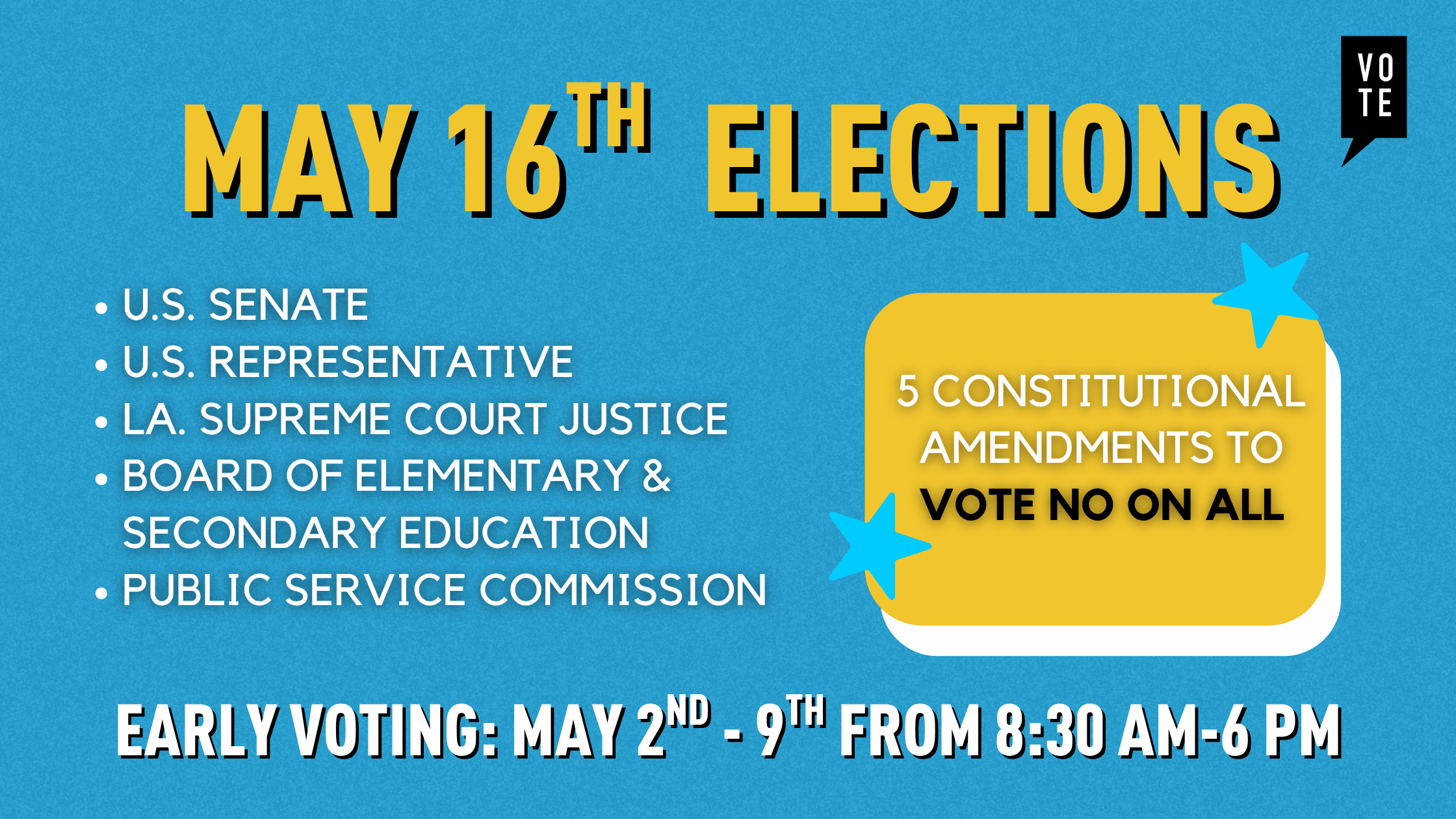
Voters rejected 4 shady constitutional amendments in March 2025. Now the Legislature is back with another set of 5 dud propositions that consolidate power, drain public resources, and block diversity on the bench. Our communities deserve better. More breakdowns to come but it's another NO ON ALL from us dawg.
If we don’t choose, we lose — so let’s prove them wrong.
Show up, show out, and vote NO.
Starting in 2026, Louisiana will use closed party primaries for certain federal and statewide races. This replaces the state’s traditional open (“jungle”) primary for those specific offices.
AMENDMENT #1
political control over state jobs
“(Y/N): Do you support an amendment to allow the legislature to remove or add officers, positions, and employees to the unclassified state civil service?”
Vote "No" on 1: The Governor and Legislature want to strip civil service protections and take control over which state jobs are protected, shifting power away from an independent system and opening the door to political hiring and firing.
vote no
What is this? Gov. Landry wants to hand politicians the power to decide which state workers can be hired and fired without cause. Right now, most state jobs are protected — you get hired on merit, and you can't be let go just because a new boss doesn't like you. An independent civil service commission holds that line. When Landry tried to reclassify 900 jobs after Trump gutted federal civil service protections, the commission blocked him. This amendment is his way around it.
What would change? The legislature — not an independent body — would decide which state jobs lose their protections. Those jobs become "at-will," meaning workers can be fired for any reason or no reason at all.
Who is impacted? State workers — many of them Black, working-class people who fought for decades to get off the plantation of political favor and onto the merit system. Anyone who's ever had a job they deserved to keep but lost because of who was in power understands why this matters.
Why it matters? We already know what happens when jobs become political. The people closest to power get protected. Everyone else gets cut. This is the spoils system dressed up in legislative language.
If it passes: Politicians gain the power to reshape the state workforce along party lines. Workers lose the shield that keeps them from being fired for refusing to play ball.
If it fails: The civil service commission keeps its independence. Merit stays the standard. Political retaliation stays off the table.
AMENDMENT #2
FUND SEGREGATED ST. GEORGE SCHOOL SYSTEM
“(Y/N): Do you support an amendment to grant the St. George community school system in East Baton Rouge Parish the same authority granted parishes for purposes of Article VIII, Section 13 of the Constitution of Louisiana, including purposes related to the minimum foundation program, funding for certain school books and instructional materials, and the raising of certain local revenues for the support of elementary and secondary schools?”
Vote "No" on 2: St. George’s wealthy residents voted to become independent of Baton Rouge. Now they want us to fund a separate school system.
vote no
What is this? In 2024, the predominantly white St. George community incorporated as its own city on the outskirts of Baton Rouge. Now they want to write their own school district into the Louisiana Constitution — taking $48.3 million in annual tax revenue with them, away from East Baton Rouge Parish schools.
What would change? St. George would operate its own school system with the same constitutional authority as a parish, including its own share of state education funding and the ability to raise its own local taxes.
Who is impacted? Every child left behind in the East Baton Rouge Parish system — disproportionately Black children and children from low-income families — who will have to make do with less money, more crowded classrooms, and fewer resources.
Why it matters? Separate is never equal. We've seen this before in Louisiana. When a community draws a line and takes its money to the other side of it, the children on this side pay the price. The fact that not a single Democrat voted for this and the area is 88% white tells you everything you need to know about what this is.
If it passes: St. George gets its own constitutionally protected school system. East Baton Rouge loses nearly $50 million a year. That gap doesn't close — it grows.
If it fails: Funding stays pooled across the parish. Every child in East Baton Rouge keeps access to a shared resource base.
AMENDMENT #3
EDUCATION TRUST FUNDS / TEACHER PAYGUT
“(Y/N): Do you support an amendment to fund a $2,250 teacher pay raise and $1,125 support staff pay raise by utilizing the remaining savings from paying down the debt of the Teachers' Retirement System of Louisiana with monies from certain constitutional funds?”
Vote "No" on 2: This flushes our educational funds down the drain while pretending to be about teacher pay raises. VOTE NO. Close a prison instead.
vote no
What is this? This amendment offers teachers a $2,250 raise and support staff an $1,125 raise — but pays for it by permanently eliminating three education trust funds worth roughly $2 billion. Those funds were built over years to support schools and students with the greatest needs. Voters rejected a nearly identical plan in March 2025. It's back.
What would change? The Education Excellence Fund, the Louisiana Education Quality Trust Fund, and the Louisiana Quality Education Support Fund would all be dissolved. The money saved from paying down teacher pension debt with those funds would free up money for raises — but the funds themselves would be gone forever.
Who is impacted? Teachers deserve raises. No question. But the students who benefit most from the long-term investments those trust funds support — children in underfunded schools, in poor and rural communities, in the communities we come from — would lose out permanently.
Why it matters? You don't fix one problem by creating a bigger one. Taking money away from the most vulnerable students to fund raises is a false choice — and a permanent one. Close a prison. Find another way.
If it passes: Teachers get a one-time raise. The education trust funds disappear forever. Future generations lose the funding floor that was supposed to protect them.
If it fails: The trust funds stay intact. The legislature has to find a real, sustainable way to raise teacher pay — as they should.
AMENDMENT #4
CORPORATE INVENTORY TAX CUTS
“(Y/N): Do you support an amendment to allow a parish to reduce or exempt property tax on property held as business inventory and to provide for the classification of Public Service Property?”
Vote "No" on 2: Lets local politicians cut corporate taxes. Big business gets enough free lunches already.
vote no
What is this? This amendment lets individual parishes choose to reduce or eliminate property taxes on business inventory. The state would cover the losses for three years. After that, parishes are on their own. Some parishes bring in $30 million a year from this tax. That money pays for schools, law enforcement, and local services.
What would change? Parishes that opt in would lose a major, stable funding source. Businesses (including large corporations) would pay less or nothing at all on goods they store in the parish.
Who is impacted? Wealthier parishes can absorb the hit. Poor parishes — the ones with fewer resources, fewer options, and more Black and working-class residents — cannot. When the money runs out, it's those communities that lose their schools, their services, and their public safety infrastructure.
Why it matters? Big business already benefits from Louisiana's tax environment. This creates a race to the bottom where parishes compete to give corporations the best deal, and working families pick up the tab.
If it passes: Corporate tax relief gets handed down to local governments with no long-term guarantee. Poor parishes either cut services or raise other taxes to compensate both options hurt the people least able to absorb it.
If it fails: Stable, consistent funding for schools and local services remains in place.
AMENDMENT #5
JUDICIAL RETIREMENT AGE
“(Y/N): Do you support an amendment to change the mandatory retirement age for judges from seventy to seventy-five, provided that a judge may continue to serve to complete a term of office? ”
Vote "No" on 2: Lets judges run for office up to 75 years old and serve into their 80s. America has problems with leaders not knowing when to pass the torch.
vote no
What is this? Louisiana currently requires judges to retire at age 70. This amendment raises that to 75, allowing judges to potentially serve well into their 80s if they're in the middle of a term. Louisiana voters have rejected this same proposal three times before.
What would change? Judges stay on the bench longer. Judicial seats open up less often. The makeup of Louisiana's courts changes more slowly.
Who is impacted? Anyone who needs the courts to reflect their community. Louisiana's judiciary is already not diverse — it does not reflect the people who appear before it, especially Black Louisianans and those who have come in contact with the criminal legal system. Fewer openings means fewer chances to change that.
Why it matters? We know from lived experience that who sits on the bench shapes who gets justice. Slower turnover, combined with ongoing concerns about gerrymandered judicial districts that limit the voting power of communities of color, means this amendment could cement an unrepresentative judiciary for a generation.
If it passes: Judges serve longer. Diversity on the bench advances slower. Structural barriers to fair representation get harder to dismantle.
If it fails: Regular turnover continues. The door stays open for new judges — including judges who look like, come from, and understand our communities.